

On paper, 2D to 3D looks simple: read the drawing, extrude the walls, drop in furniture, render. In practice, it is one of the great unsolved problems of computer vision – because floor plans compress complex 3D intent into a dense, lossy, highly stylized 2D language.
A typical residential floor plan mixes ultra-thin lines for partition walls with thicker lines for structure and broken lines for openings; dozens of domain-specific symbols for doors, windows, stairs, plumbing, and electrical; and crowded text at odd angles for room labels, dimensions, and material notes, often overlapping the graphics. Humans learn this visual code over years of studio work. Off-the-shelf computer vision models see it as noisy, cluttered clip art – and often fail at the basics.
What Existing Research Has Achieved
Academic work has pushed the field forward, but each approach tends to solve only part of what architects and interior designers need. Classical methods parse CAD floor plans into components, restore wall integrity, and reconstruct a 3D shell. More recent deep learning approaches use image segmentation to identify walls, doors, and windows, then predict heights and generate editable 3D meshes. Some systems go further: Cornell’s C3Po model aligns real interior photos with floor plans, reducing pixel-to-plan correspondence errors by around a third versus prior methods.
These systems prove that 2D to 3D is solvable in controlled settings, yet most are prototypes limited by strict input formats and narrow deployment contexts. They rarely deal with the messy, heterogeneous, low-quality plans that residential developers and architects handle every day – scans, phone photos, exported PDFs with wildly different resolutions.
Floor Plans as a Specialized Visual Language
The key shift at VirtualSpaces is treating floor plans as a specialized visual language rather than just images with text. The symbols, line weights, hatch patterns, and annotations form a structured grammar that encodes how people design homes and how families live in them.
The engine reads that grammar in several layers. The geometry layer captures walls, doors, windows, structural openings, and the basic topology of rooms and circulation. The semantic layer extracts room types, labels, dimensions, orientation, adjacency, and connectivity. The intent layer infers likely furniture zones, focal walls, daylight directions, privacy gradients, and usable wall lengths. This is where AI, OCR, and computer vision genuinely converge: 2D to 3D is not just a geometry problem – it is a linguistic one.
Inside the VirtualSpaces Pipeline
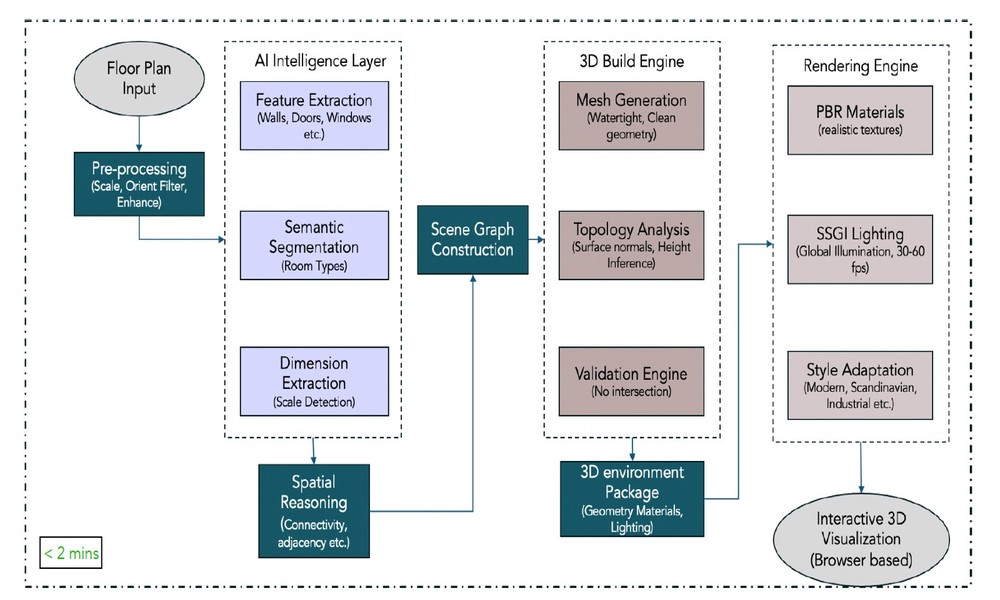
A typical 2D floor plan passes through several stages. Pre-processing detects scale and orientation, reduces noise, and cleans linework – critical because floor plans arrive in the wild as scans, phone photos, and PDFs with wildly different resolutions. An AI intelligence layer then performs feature extraction to isolate walls, doors, windows, and structural elements; semantic segmentation to detect room types; and spatial reasoning to map adjacency and connectivity so that circulation paths and sightlines make sense.
These entities are assembled into a structured scene graph that represents a home rather than just a collection of polygons. A 3D build engine creates watertight geometry, infers heights and floor level changes, and validates that doors are not colliding with walls. Finally, a rendering engine applies physically based materials and Screen Space Global Illumination (SSGI) lighting to produce photoreal interior design renders that run in a standard browser – the same engine powering Foursite‘s AI interior décor and AI virtual staging capabilities.
This entire flow – from floor plan input to interactive 3D environment – runs in minutes instead of the days or weeks that external 3D artists require.
What This Means for Designers and Architects
For architects and interior designers who design homes every day, the gains are practical. Teams can upload 2D floor plans, run blueprint to 3D in minutes, and present multiple layout options or AI virtual staging concepts without outsourcing to render studios. Home buyers understand volume, light, and furniture fit much earlier – and decisions come faster.
Instead of bouncing between CAD, BIM, and ad-hoc rendering services, the same pipeline handles floor plan to 3D, AI interior design, and AI interior décor inside one experience. For residential developers running many unit variants at once, this is a meaningful operational simplification. Designers remain in control of intent and taste; the system handles heavy lifting – extracting structure, keeping materials consistent, testing multiple styles – so humans can focus on designing for people.
Beyond Architecture: A General Technical Document Parser
Once you view 2D to 3D for homes as “technical document understanding plus spatial reasoning,” it becomes clear that architecture is a starting point, not a ceiling. A technical document parser that has learned the specialized visual language of residential architecture can, with retraining, be extended to structural engineering drawings – recognizing rebar layouts and load paths; MEP plans – parsing HVAC, plumbing, and electrical routes; and even circuit schematics, understanding components and connectivity to generate 3D panel layouts that match manufacturing constraints.
Why This Space Is Still Underserved
Despite research momentum and consumer tools that promise “upload a blueprint and get a 3D model,” most professional residential teams still rely on manual CAD, offline render studios, and fragmented workflows. Few systems handle the breadth of real-world plan formats that appear across regions and decades. Generic OCR and computer vision stacks cannot reach the precision needed for permitting, sales, and construction drawings. Most academic systems stop at clean 3D shells instead of delivering the AI visualization that stakeholders actually need.
By treating floor plans as a specialized visual language and tying the result directly to photoreal AI interior décor and virtual staging workflows, VirtualSpaces is working to close that gap. For technologists, residential developers, architects, and homeowners alike, that shift turns 2D to 3D from an offline service into a core capability that lives at the heart of how we design spaces for people.
