

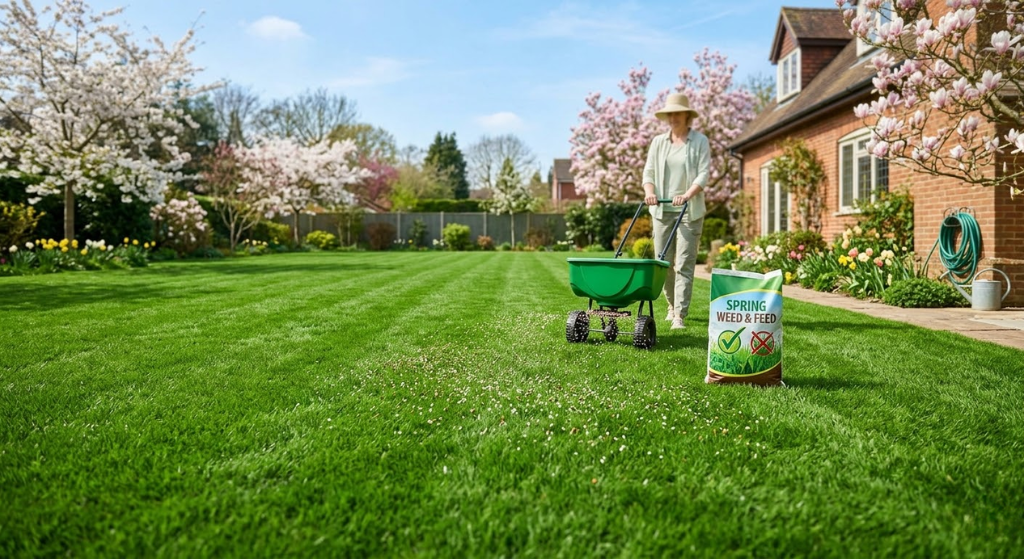
The Best Weed and Feed for Lawns depends on your grass type, weed problem, and season, but Scotts Turf Builder Weed & Feed is often considered a strong choice for most lawns. It covers up to 5,000 sq ft, works on broadleaf weeds, and is compatible with most common grass types. Apply it in spring or fall when weeds are actively growing and the soil is moist.
That said, the wrong product on the wrong grass type at the wrong time will damage your lawn rather than improve it. Here’s everything you need to know before you buy.
What Weed and Feed Actually Does
These products contain two separate active components working simultaneously:
- The weed control component is a herbicide – usually a broadleaf herbicide that targets dandelions, clover, chickweed, and similar weeds while leaving grass unharmed. Some formulas are pre-emergent (prevent weed seeds from sprouting) while others are post-emergent (kill existing weeds).
- The fertilizer component delivers nitrogen (N), phosphorus (P), and potassium (K) to feed the grass. The ratio of these three elements – shown as three numbers on the bag like 28-0-3 – determines what the fertilizer does for your lawn.
N-P-K Quick Guide:
| Nutrient | Role in Lawn Health | Look for When… |
| Nitrogen (N) – first number | Drives green leaf growth and density | Lawn looks pale, thin, or slow-growing |
| Phosphorus (P) – second number | Supports root development | New lawn or overseeding (often 0 in weed-and-feed) |
| Potassium (K) – third number | Disease resistance, drought tolerance | Lawn under stress; high traffic areas |
Types of Weed and Feed
| Type | How It Works | Best Season | Best Grass Type |
| Pre-emergent granular | Creates a barrier preventing weed seeds from germinating | Early spring (before soil hits 55°F) | All types; most common |
| Post-emergent granular | Kills weeds already growing; must adhere to wet leaves | Spring or fall when weeds are actively growing | Cool and warm season grasses |
| Liquid weed and feed | Sprayed directly – faster uptake, more precise coverage | Spring/fall; works faster than granular | All types; good for spot treatment |
| Organic/natural blend | Slow-release fertilizer with corn gluten or natural herbicide | Spring for pre-emergent effect | All types; safest for kids/pets |
Top Weed and Feed Products
| Product | Type | Coverage | N-P-K | Best For | Price |
| Scotts Turf Builder W&F | Post-emergent granular | 5,000 sq ft | 28-0-3 | Most cool-season lawns | ~$25-35 |
| Scotts Turf Builder for Southern Lawns | Post-emergent granular | 5,000 sq ft | 29-0-10 | Bermuda, St. Augustine, Zoysia | ~$25-35 |
| BioAdvanced 3-in-1 Weed & Feed | Granular + grub control | 5,000 sq ft | 18-0-6 | Lawns with grub problems too | ~$30-45 |
| Espoma Organic Weed & Feed | Organic pre-emergent | 2,500 sq ft | 8-0-0 | Organic-conscious homeowners | ~$30-40 |
| Spectracide Weed & Feed | Post-emergent liquid | 5,000 sq ft | 15-0-1 | Fast-acting; visible results in days | ~$20-30 |
| Jonathan Green Organic W&F | Organic granular | 5,000 sq ft | 10-0-2 | Families with kids and pets | ~$35-50 |
Best Overall: Scotts Turf Builder Weed & Feed
Scotts has dominated the consumer lawn care market for good reason – their Turf Builder Weed & Feed formula is well-tested, widely available, and works reliably on the common broadleaf weeds (dandelion, clover, chickweed, plantain) that plague most lawns.
The 28-0-3 NPK ratio means it’s heavy on nitrogen for green growth and includes potassium for resilience. The post-emergent formula requires the lawn to be wet for the granules to adhere to weed leaves – apply after rain or irrigate first, then don’t water again for 24-48 hours.
Best for Warm-Season Grasses
Scotts Turf Builder for Southern Lawns is specifically formulated for the warm-season grasses common in the South: Bermuda, St. Augustine, Zoysia, and Centipede. These grasses have different fertilizer needs and different weed pressures than northern lawns, and using a northern formula on them can cause discoloration or damage.
The higher potassium (10) reflects the heat and drought stress these grasses routinely face. If you’re in Texas, Florida, Georgia, or the Carolinas, this is the version to use.
Best Organic Option: Espoma or Jonathan Green
Organic weed and feed products use corn gluten meal as the pre-emergent component – it releases proteins that inhibit root formation in germinating weed seeds. It’s not as immediately effective as synthetic herbicides, but it’s safe around children and pets immediately after application and improves soil biology over time.
If you have young children or dogs who use the lawn regularly, the peace of mind may be worth the slightly higher cost and the understanding that results take longer.
How and When to Apply
- Mow your lawn 2-3 days before application to ensure weeds are at a good height to absorb the herbicide.
- Water the lawn thoroughly the day before – or apply after rain. The granules need moisture to stick to weed leaves.
- Apply using a broadcast or drop spreader at the rate specified on the bag. Don’t guess; over-application burns grass.
- Do NOT water for 24-48 hours after application – washing the granules off the weeds prevents the herbicide from working.
- Keep children and pets off the lawn until the product has dried completely (usually 24 hours).
- Apply when temperatures are between 60-90°F. Too cold and the herbicide doesn’t work; too hot and fertilizer can burn grass.
Mistakes That Damage Your Lawn
| Mistake | What Happens | How to Avoid It |
| Applying in summer heat | Fertilizer burns grass when temperatures exceed 90°F | Stick to spring and fall applications |
| Over-applying | Chemical burn – yellow or brown patches | Follow bag rate exactly; calibrate spreader first |
| Using on wrong grass type | Some products damage Bermuda, St. Augustine, or fine fescues | Read the label – grass compatibility is listed |
| Applying before rain | Product washes off weeds before it can work | Check 48-hour weather forecast before applying |
| Applying near vegetable gardens | Broadleaf herbicide kills tomatoes, peppers, and many vegetables | Keep 10+ feet buffer from edible gardens |
Safety: Kids, Pets, and the Environment
Most weed and feed products instruct keeping children and pets off the treated lawn until dry – typically 24 hours. After that, residue levels are generally considered safe at normal exposure.
For extra caution: choose granular over liquid (less drift), apply on a calm day (no wind spreading product), and avoid application near storm drains, streams, or bodies of water. Herbicide runoff is a genuine environmental concern – avoid over-application near drainage areas.
If you have genuine concerns about chemical exposure, Jonathan Green Organic or Espoma Organic are legitimate alternatives that pose minimal risk while still improving lawn health meaningfully over time.
